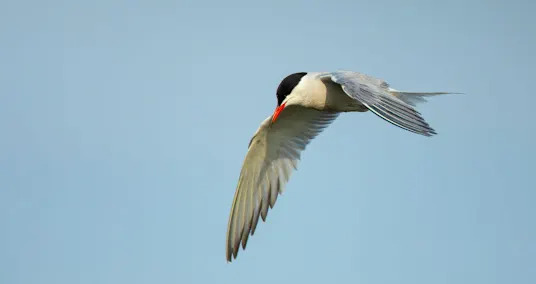
An RSPB reserve will construct a "beach-style" nesting pontoon for a species of seabird that breeds at the site.
Colonies of common terns migrate from Africa for the British summer, and raise their young at St Aidan's nature park near Castleford.
The wildlife charity has secured funding for a shale beach pontoon to replace the small wooden rafts that the birds had previously nested on.
Lydia Teague, manager at the RSPB's reserves in the Aire Valley, said the amber-listed common tern was "absolutely stunning, beautiful".
Teague said the species was nicknamed "sea swallow" because of its size and forked tail.
She added: "They take advantage of the small fish we have up here and our nice long days to raise their young."
Common terns prefer areas surrounded by water with protection from ground predators.
They nest on shingle beaches, but are increasingly suffering from disturbance and are now classed as at moderate risk of conservation concern because of significant population decline in the past 40 years.
Teague said: "Common terns do nest in continental Europe but we want to make sure we don't lose these species from the British Isles."

The new artificial raft at St Aidan's will mean the birds "can settle together and feel safer," she added.
It will also reduce competition with the larger black-headed gull for breeding space at the site, as both species prefer the same habitat.
The pontoon will be installed at a time that is beneficial to the terns to prevent other birds colonising the space first.
"The common tern arrives back in the UK from mid-April," Teague said.
"Black-headed gulls have already settled down by then and are sitting on their nests.
"It's all in the timing."
Listen to highlights from West Yorkshire on BBC Sounds, catch up with the latest episode of Look North.
LATEST POSTS
- 1
 Soldiers seize power in Guinea-Bissau and detain the president
 - 2New movies to watch this weekend: See 'They Will Kill You' in theaters, rent 'Send Help,' stream 'Pretty Lethal' on Prime Video
- 3Find the Specialty of Public Speaking: Drawing in and Convincing Crowds with Certainty
- 4Dwayne ‘the Rock’ Johnson opens up about being the 'new guy' again — and why this moment feels like a new life
- 5Flu season is just beginning, but doctors are already on high alert




- Inside Plan with Houseplants: An Aide
- This professional Santa's dream of spreading holiday cheer fuels stroke recovery
- Sports Shoes of 2024: Upgrade Execution and Solace
- Former United Launch Alliance CEO Tory Bruno joins competitor Blue Origin for national security projects
- Finding the Force of Mentorship: Self-awareness Through Direction
- NASA’s Pandora telescope will study stars in detail to learn about the exoplanets orbiting them
- Vote in favor of the pasta that makes good dieting pleasant!
- Experience Is standing by: 10 Pleasant Setting up camp Areas to
- Songbirds swap colorful plumage genes across species lines among their evolutionary neighbors